Nurse-injected · Conservative dosing
Theunder-correct-firstapproachtoBotox.
I'd rather dose you 15% lighter than you expected and see you back at two weeks, than hand you a frozen forehead and apologise for it. That's the whole protocol.
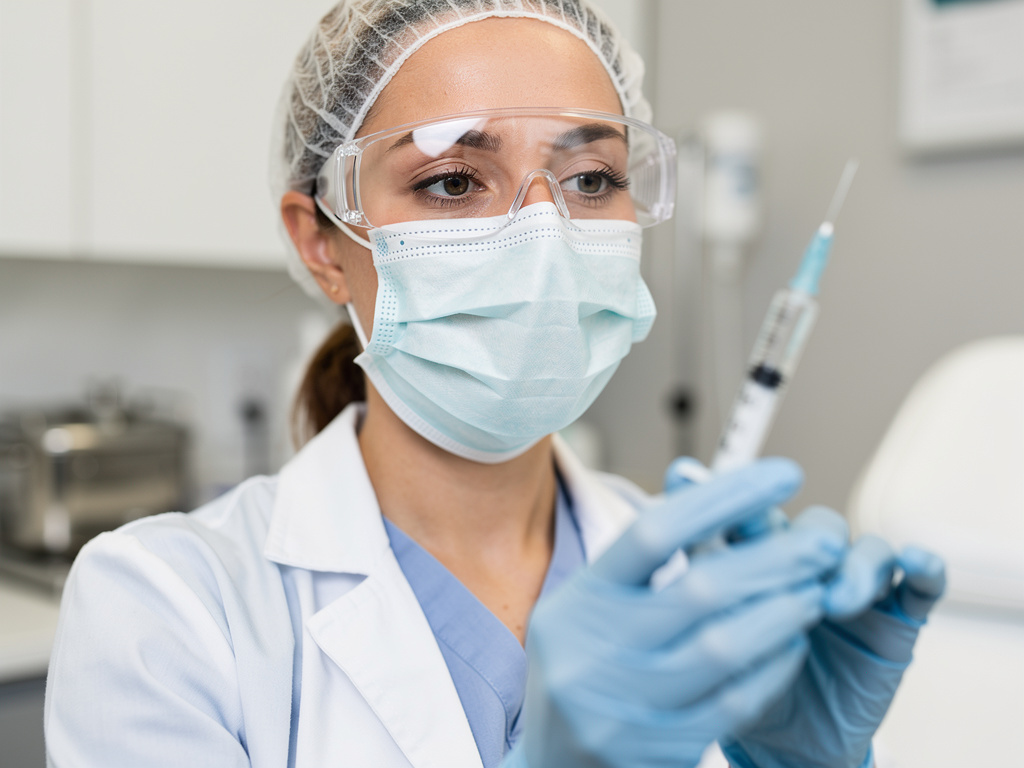
A case that shaped the protocol
A client came in eight months ago wanting me to fix her forehead.
Thirty-seven. Two kids. An injector somewhere in Farmington had given her 50 units across the upper face on a single visit. Her eyebrows wouldn't lift, her forehead couldn't express, and she'd been walking around looking perpetually startled for six weeks.
She was not frustrated with Botox. She was frustrated that she'd paid $600 to look like she was perpetually mid-sneeze. I had her wait it out — Botox is not reversible, you cannot dissolve it like filler, you wait. Three months later I saw her again and we started over, carefully. Twelve units. Glabella only. Review at two weeks.
By the one-year mark she was on 28 units total across upper face, seeing me every three-and-a-half months, and looking entirely like herself. Just rested.
That client shaped how I do every first session now. I'd rather be the injector you're slightly underwhelmed by at day ten and pleasantly surprised by at day fourteen, than the one who costs you three months of your face.

Sarah Mitchell, RN
Registered Nurse Injector · Bravo MedSpa
What Botox actually does, without the marketing.
Botulinum toxin type A blocks the signal between nerve and muscle at the injection site. The muscle can't fire for a few months. If the muscle can't fire, it can't pull the overlying skin into the dynamic crease we call a wrinkle. Fewer pulls, fewer wrinkles.
It is not a filler. It does not add volume. It does not improve skin tone. If your concern is volume loss under your cheekbones or a deepening line that's visible when your face is still — you want filler, not Botox. A useful rule: if the line is only there when you make an expression, Botox is the tool. If the line is there when your face is blank, you need something else — or both.
The injection itself is a small needle (30–32 gauge), no anaesthesia required, takes maybe eight minutes for a full upper face. You'll see the effect starting around day four and fully settled at day ten to fourteen. This is why our first-session price always includes a review appointment exactly at the two-week mark.
Four neurotoxins, one right match
Botox, Dysport, Xeomin, Jeuveau — when I pick which.
Same mechanism, different formulation. Your face responds differently to each. I pick based on your history, your goals, and where I'm injecting — not which rep has the current promotion on my shelf.
| Product | Per-unit price | Onset | Sarah picks it when |
|---|---|---|---|
| Botox Cosmetic | $12–$15 | 3–5 days | The first-session default. Most predictable spread, most clinical data, safest starting point. |
| Dysport | $4–$5 | 2–3 days | Forehead with broad, even diffusion. Not my pick for crow's feet (spreads too wide for that zone). |
| Xeomin | $12–$14 | 4–6 days | Long-term Botox clients whose duration has started dropping. No complexing proteins, lower antibody risk. |
| Jeuveau | $11–$13 | 2–3 days | Clients going to an event in less than a week. Fastest visible onset of the four. |
Dysport's per-unit price looks dramatically lower because its units are smaller — roughly 2.5 Dysport units equal 1 Botox unit. The math works out similar. Don't let the per-unit number alone drive your decision.
What nobody wants to talk about
When your Botox stops working — and why most clinics don't bring it up.
Roughly one in twenty long-term Botox clients eventually develop tachyphylaxis — a reduced response to the same dose they used to get results from. Their three-month results become two months. Then six weeks. Then they're back in the chair asking why their Botox isn't working.
Most clinics either shrug it off ("just add more units") or quietly double the dose without naming what's happening. Adding units works for a while. Then it doesn't. Because the actual mechanism is immune: your body is producing neutralising antibodies against the complexing proteins that come packaged with Botox.
Here's what I do when I see it. I switch the client to Xeomin for six to twelve months. Xeomin is what's called a "naked" toxin — no complexing proteins, substantially lower immunogenic profile. Over that window, the antibodies decrease. Then we either stay on Xeomin or cycle back to Botox at reduced frequency. In my experience, about 70% of tachyphylaxis clients regain full Botox response after a Xeomin break.
If you've been on Botox for more than five years and feel like it's not lasting like it used to, this is the conversation nobody's having with you. Bring it up at consultation.
When I say no
Who I won't inject, and why.
If you're pregnant or breastfeeding, I defer. The data on Botox in pregnancy is insufficient, and I will not elective-inject someone in either state. Neither should anyone else.
If you have a neuromuscular condition (myasthenia gravis, Lambert-Eaton syndrome, ALS), Botox can exacerbate it. I will ask about medication and family history. If anything comes up, we stop.
If your line concern is primarily static (visible when your face is blank), Botox is not the first answer. Fillers, RF microneedling, or time-plus-sunscreen are. I'll tell you that at consultation rather than take your $800 and hand you a subtle result you'll consider disappointing.
If you've had a bad result elsewhere in the last three months, I'll probably ask you to wait out your previous treatment before we start fresh. Injecting over active product is how we end up with asymmetries that are nobody's fault in particular but everyone's problem.
If you're under 25 with no visible dynamic lines yet, I'll talk to you honestly about preventative Botox. Sometimes it makes sense. Often it doesn't. See our guide on when to actually start.
What you'll pay
Per-unit pricing. No package lock-ins. No estimates that become bills.
Botox, Xeomin, and Jeuveau are $12–$15 per unit. Dysport is $4–$5 per unit (at roughly 2.5× the dose, so the total lands similar). First-time clients save 10% on the initial visit.
A typical upper-face plan (forehead + glabella + crow's feet) lands between 40 and 60 units, or $600 to $900. Masseter for jaw clenching or TMJ is 25 to 40 units per side, so $600–$1,200 for the full treatment. Lip flip is 4–8 units, under $100.
Every plan is written down before you're injected — product, units, area, total dollar figure. You sign off on the number, and that's what you pay. If I reduce the dose during the session (because your muscles respond more than expected), your bill drops. If we're over the plan, I stop and confirm with you before adding.
The two-week review is included. If anything is under-corrected, I add the needed units at no additional charge. This is not a retention gimmick. It's how I've ensured first-time clients don't leave with a face I couldn't verify.
The review protocol, explained once
Why I ask every new client to come back at day fourteen.
Botox takes ten to fourteen days to fully set. At the moment I inject you, I cannot tell you what your final result will look like. Nobody can. We are working from a clinical estimate based on your muscle thickness, prior history, and the specific zones we're treating.
At day fourteen, I look at you. If anything looks asymmetric — one brow slightly higher than the other, a forehead zone that didn't soften as much as we hoped — I adjust. Usually with 2 to 4 additional units. At no charge. The review is booked into every first-time appointment.
Clients who've been with me for a year or two often skip the review because we know how their face responds. New clients do not skip it. If a clinic is offering Botox without a follow-up policy, that's a red flag — one they should not be able to charge $800 to ignore.
Where we are
I run Botox clinics at both Bravo locations: the West Hartford flagship on 61 South Main and our Rocky Hill location on 825 Cromwell. Lunch-hour slots (11:30, 12:00, 12:30) book up fast — especially among clients at Aetna, Travelers, The Hartford, and Cigna — so book those ahead if your schedule is tight.
If you're from Simsbury, Avon, or Farmington, West Hartford is faster. If you're from Glastonbury, Newington, or Cromwell, Rocky Hill is faster. I split my weeks between both, so you can build a relationship with whichever location works for your life.
Want to talk it through first?
A consultation is the right step if you have specific anatomy, history, or goals to discuss before committing.
Book ConsultationBotox & injectables
Things clients ask me at consultation
Under-correct. Review. Adjust.
Book a careful first session.
Forty minutes, written plan, no pressure. I'd rather lose a client at consultation than treat one I shouldn't be treating. Same-day injections only after consultation.