Real laser, not IPL · Fitzpatrick I–VI
Thelaser,andonlythelaser.
Most "laser hair removal" in Connecticut isn't laser. It's IPL. The distinction matters — for results, for skin-tone safety, and for the price you're paying. We're licensed, trained, and operating on a medical-grade dual-wavelength platform. Here's what that actually means.
Before we go further
The "laser" that isn't a laser, and why it matters.
A laser is a device that emits coherent light at a single specific wavelength. Ours emits at 755 nanometres (Alexandrite) and 1064 nanometres (Nd:YAG). Those numbers are not marketing — they're the physics of what wavelength penetrates to what depth and is absorbed by what pigment target.
IPL — intense pulsed light — is not a laser. It is a flashbulb that emits a broad spectrum of wavelengths simultaneously, somewhat like a very bright camera flash. IPL devices are legal to operate, can legitimately reduce some hair in some clients, and are significantly cheaper per treatment. The problem is marketing. Salons and spas routinely describe IPL treatments as "laser" because it's a more impressive-sounding word. Groupon listings almost universally use "laser." The client often doesn't know they're not getting what they think they're getting.
Why it matters: IPL is not safely tunable across skin tones. The broad spectrum includes wavelengths that are absorbed by epidermal melanin — which is why IPL carries meaningful burn and hyperpigmentation risk on Fitzpatrick IV–VI skin. A real laser can be selected (Nd:YAG at 1064 nm) to bypass epidermal melanin and target the follicle specifically. The difference isn't theoretical; it's visible on the skin of the client.
If you've had "laser hair removal" before and saw limited results, burned skin, or persistent hyperpigmentation — there's a reasonable chance you were treated with IPL. If it's happened to you, I'd like to know at consultation. It changes the patch-test approach and sometimes the expected outcome.
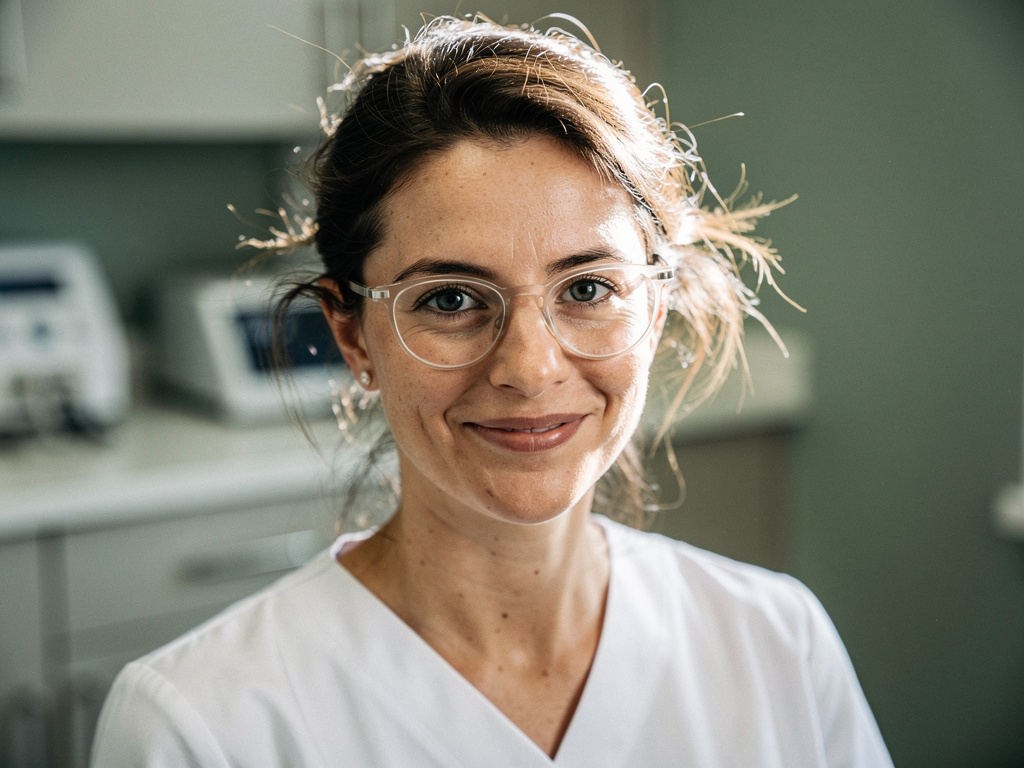
Samantha Jones
Laser Technician · Connecticut-licensed
The wavelength decision
How I pick 755 nm vs 1064 nm at your first session.
Both wavelengths work. Which one I use depends on your skin type, hair density, and where on your body we're treating. The decision is not arbitrary and it's not the same for every client.
| Wavelength | Skin type (Fitzpatrick) | Strength | Where I use it |
|---|---|---|---|
| 755 nm Alexandrite | I, II, III (pale to light-medium) | Faster treatment, better superficial follicle capture | Face, underarms, bikini, arms. The workhorse wavelength for lighter skin. |
| 1064 nm Nd:YAG | IV, V, VI (medium to deep) | Penetrates past epidermal melanin safely | All zones on deeper skin tones. Mandatory — I will not use 755 on Fitzpatrick IV+. |
| Both (mixed protocol) | III–IV boundary | Combined superficial + deep capture | Coarse body hair on medium-tone skin. 755 pass followed by 1064 pass. |
A client I see every 8 weeks
Thirty-two, PCOS-positive, four years of tweezing and threading.
She came to me after two separate "laser" courses at other clinics in the Hartford area. First course was IPL marketed as laser — it didn't work on her chin hair and caused a patch of hyperpigmentation on her upper lip that took 11 months to clear. Second course was a real Alexandrite laser but at incorrect fluence — slight improvement, not dramatic, session six felt the same as session three.
At consultation we went through her history, did a patch test at two fluence settings, and set a conservative dose. I chose 755 nm for chin and upper lip (Fitzpatrick III), 6-week intervals. Session one was uneventful. Session two she saw a clear reduction in density. By session five, her facial hair load was reduced by roughly 70%.
Here's what PCOS hair requires that general laser hair removal doesn't: a longer series (10–12 sessions often, vs 6–8 for non-hormonal hair), and ongoing maintenance every 8–12 weeks rather than annually. Her hormones will keep activating new follicles for as long as her PCOS is active. This is a managed condition, not a finished project.
She's one of six regular PCOS clients I see now. All of them had been misquoted elsewhere — told "6 sessions and you're done" when the clinical reality is ongoing. If you have PCOS and you're reading this, please come in for a consultation where the plan is honest from session one.
What the series actually looks like
Session-by-session expectation.
Session 1 (week 0): Consultation, Fitzpatrick assessment, patch test, first treatment at conservative fluence. You'll shed hair over the next 10–14 days. Do not expect dramatic reduction yet.
Session 2–3 (weeks 6–12): You'll see reduction — 20–30% typically. New hair growth is finer and sparser. We may increase fluence if your first session tolerated it well.
Session 4–6 (months 4–8): 50–70% permanent reduction. Many clients stop shaving a treated zone entirely by session 5. Fluence plateaus at your optimal setting.
Session 7–8 (months 9–12): Finishing passes. Final reduction lands at 70–85% in most non-hormonal clients.
Year 1+ maintenance: One session per year for most clients. Hormonal clients (PCOS, menopause) maintain every 8–12 weeks.
When I send clients away
Who the laser cannot help.
Blonde, red, grey, or white hair. No pigment target. Electrolysis is the only modality that works on non-pigmented hair, and it's not offered at Bravo — I'll give you a referral.
Active tan or self-tanner. We reschedule. Two weeks of true sun avoidance is required before first session.
Recent Accutane use. 6-month wait after the last dose. Accutane sensitises skin and burns become likely at normal laser fluence.
Photosensitising medications. St. John's wort, certain antibiotics (doxycycline), retinoid courses — we'll review at intake and may adjust timing.
Active cold sore or herpes in the zone. Delay until cleared. Antiviral prophylaxis for upper lip treatment in clients with HSV history.
Pregnancy. Defer until postpartum.
Pricing
Per-zone pricing. Package of 6 saves 15%.
Upper lip or chin: from $50 per session. 5–15 minutes in the chair.
Underarms: from $75. A 10-minute session. One of the highest-satisfaction zones.
Bikini / Brazilian: from $125 (bikini) to $200 (full Brazilian). 20–30 minutes.
Full legs: from $250 per session. 45–60 minutes.
Back or chest: from $200 per session. 30–40 minutes.
Package of 6: 15% off the per-session price when purchased up front. This is what I recommend most new clients do after the first session. The math only works if you're committed to the full series — don't buy 6 if you're unsure.
Both locations
I operate the laser at both West Hartford and Rocky Hill, typically splitting weeks. For multi-session packages I'll keep you at whichever location works for your schedule — the laser is the same platform at both, and I log your fluence settings in your chart so any session is continuous with your prior.
The best time to start a laser series in Connecticut is October through March — the sun-avoidance rule between sessions is easier to honour in cold months. Most bridal clients I see start 10–12 months before the wedding for legs; 8 months for underarms and bikini; 12 months for face work.
Related services
Pre-session prep
Shaving, sun, retinoids, and why the day-before rules matter.
Want to talk it through first?
A consultation is the right step if you have specific anatomy, history, or goals to discuss before committing.
Book ConsultationLaser hair removal
Technical questions, answered technically
Licensed. Calibrated. Patch-tested.
Book a patch test.
First visit includes Fitzpatrick assessment, patch test, and a straight answer about what a real series will take. No pressure on the package.