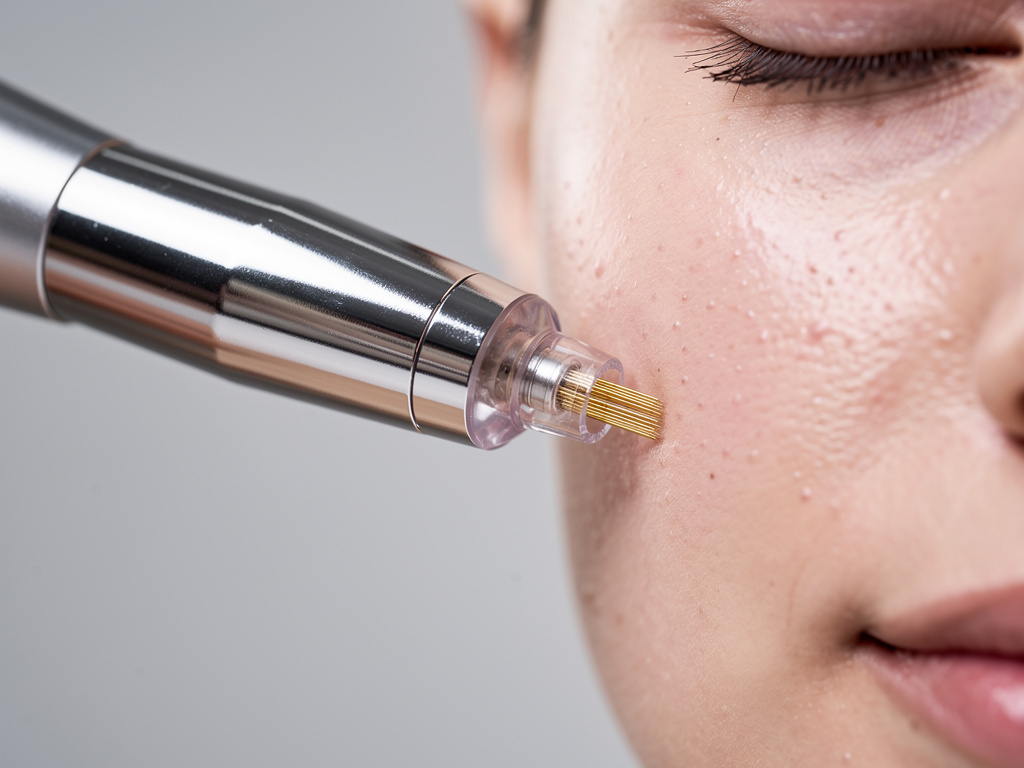
The protocol nerd's favourite treatment
RFmicroneedling—therealone.
Every clinic claims to offer this. Very few deliver the actual dermal remodelling it's capable of, because most run it on one pass at shallow depth and call it good. Here's what's actually different about how we run it.
Let's start with what nobody explains
Morpheus8 vs Genius vs Secret vs Vivace — and why the brand name might matter less than you think.
When clients ask me "do you use Morpheus8?" my honest answer is something like this: the device is one of four major RF microneedling platforms on the US market, and any aesthetician who tells you it's categorically better than Genius, Secret, or Vivace is either a brand rep or hasn't run all four on live clients.
I've personally operated three of the four. They all work. What varies isn't the hardware — it's the depth settings, the pass count, the cooling protocol, and whether the person holding the hand-piece knows when to go deeper vs stay superficial.
Marketing has turned the device question into a tribal loyalty thing. Morpheus8 got aggressive celebrity-endorsement adoption. Genius had the gold-standard device reputation among early adopters. Secret has a broad derm-practice install base. Vivace is the newer entrant with extremely good numbers for pain tolerance.
Here's my actual position: we chose our platform after testing three of them on staff and friends-of-staff over a six-week window. We picked the one that had the best combination of depth range (we needed 3.5mm for scar work), cooling comfort, and operator precision. We run three passes at decreasing depth — most clinics run one pass and bill it as a full session. The device name isn't the story. The protocol is.

Diana Lee
Aesthetician · Bravo MedSpa
The four devices, honestly ranked
How I'd describe each if you asked me over coffee.
| Device | Max depth | Strength | Diana's take |
|---|---|---|---|
| Morpheus8 | 4 mm (body) | Marketing + brand recognition | Solid device. Premium price (which clients partially pay for the brand). Operator skill is still the variable. |
| Genius RF | 3.5 mm | Precision + real-time impedance | Derm-favourite. The hand-piece reads tissue density and adjusts energy in real-time. Beautiful for dark-skin protocols. |
| Secret PRO | 3.5 mm | Broad installed base | Reliable mid-tier. Not as premium as Genius, not as marketed as Morpheus8. Works. |
| Vivace | 3.5 mm | Comfort + LED finish | The most tolerable session of the four. Built-in LED finish is a nice touch. Slightly less aggressive on deeper scarring. |
What's actually happening in there
The physics of RF microneedling, kept simple.
Okay so here's what's going on. Imagine your skin has three layers: the top (epidermis), the middle (dermis), and the deep (subcutaneous). The middle layer is where collagen and elastin live. That's the layer that actually determines how firm and smooth your skin looks.
Topical products barely reach it. Traditional microneedling touches it but doesn't deliver enough energy to remodel it. Ablative laser hits the TOP layer hard, which gives results but also gives you 10 days of peeling and a meaningful hyperpigmentation risk for darker skin.
RF microneedling threads a needle — literally — through the top layer and deposits heat exactly where the collagen lives. The insulation on the needle shaft means the epidermis barely gets warm. All the thermal work happens at the tip, deep in the dermis, which is exactly where we need it.
The controlled thermal injury triggers your fibroblasts (the cells that make collagen) to wake up and produce new structural protein over the following 90 days. Three sessions over 6–8 weeks gives your fibroblasts three sequential waves of "ok, time to rebuild." Peak collagen response lands around week 10–14 after the final session.
That's why single-session clients are always disappointed. The mechanism is cumulative. One session = a fibroblast whisper. Three sessions = a fibroblast concert.
Diana's take
"If I could only offer one skin treatment at Bravo, it would be this one. Not DiamondGlow, not PRP, not fillers. This is the treatment where I regularly see clients cry happy tears at their 3-month review photos. It's my favourite thing I do."
A session, start to finish
What a Thursday afternoon at session 2 actually looks like.
A client I've been working with for about four months comes in at 1:45pm for session two of her series. She's in her early forties, had her first session six weeks ago, and today she's here to build on the collagen work we started. She's a Fitzpatrick III — light to medium skin, minimal hyperpigmentation history.
We take progress photos before I do anything. Comparing them to her baseline from eight weeks ago, her texture is already visibly smoother. Some of the fine forehead lines that were obvious at intake have softened. Her skin looks fresher. This is normal at the 6-week mark of a 3-session series, but it's still nice to see.
I apply the topical numbing — a compounded lidocaine-tetracaine cream — and she scrolls her phone for 45 minutes in our treatment chair. Podcast in, blanket over her lap. Most clients fall into a half-doze during this part.
I clean the numbing off, drape her, and start pass one at 1.0mm depth. We're working the forehead and temples first, where the skin is thinner. She reports pressure and warmth but nothing she'd call painful. Pass one takes about 12 minutes.
Pass two at 2.0mm, focused on cheeks and jawline. This is where clients feel the most. Two zones where she needs the deepest work: a slight nasolabial fold and the jawline edge where we're trying to restore a bit of firmness. 15 minutes.
Pass three at 2.5mm, targeting a specific acne scar cluster on her right cheek. She'd had cystic acne in her early twenties and there's a patch of about four pitted scars that haven't responded to DiamondGlow or traditional resurfacing. This is why she booked RF — this is the deep dermal work. 8 minutes.
I finish with a cooling hyaluronic mask and 15 minutes of LED red light. Her skin is pink and a bit warm. She's a little pinker than she was at session one because we went deeper on pass two and three — which was the plan. She walks out at 3:20pm, goes home, and we've scheduled session 3 for six weeks from today.
At session 3, she'll show me the full response to sessions 1 and 2. At her 12-week post-series photo review, we'll compare to that baseline from four months ago and almost certainly see something that looks like a different face.
Protocol obsession
Why the 3-session series is non-negotiable.
Collagen production after a single RF session peaks at week 10–14 and fades into a new baseline. Your skin is improved but the lift is limited.
Session 2 (6 weeks later) fires the fibroblasts again while the first wave of new collagen is still being laid down. Session 3 (another 6 weeks) hits them during the second wave. The responses layer. You don't get 3× one session's result — you get something closer to 5× or 6×, because the waves compound.
I won't book a client for a single session unless they're a past series client doing a maintenance top-up. If budget is the concern, we'll stretch the series — 8-week intervals instead of 6 — rather than do fewer sessions. The cadence is the whole point.
The PRP question
Should you add PRP? My honest recommendation per use case.
If you're treating acne scars: yes, do the PRP. The growth factors measurably amplify the collagen response. It's worth the $500 add-on per session. This is the use case it's designed for.
If you're treating fine lines + general anti-age: honestly, it's nice but not essential. Most of the lift comes from the RF itself. I'd rather you do three RF sessions without PRP than two sessions with PRP.
If you're treating stretch marks or body zones: mixed evidence. I sometimes recommend PRF (platelet-rich fibrin — newer, slower release) for body zones instead of PRP. We'll pick at consultation.
You can read our PRP / PRF deep-dive for the full mechanism. The short version: your own blood, spun to isolate growth factors, applied topically post-RF while the channels are still open. It's not a scam, it's not a miracle. It's a meaningful amplifier for specific indications.
Pricing
Per-session pricing. Series discount baked in.
Single session: $1,250. Face only. Includes numbing, 3-pass protocol, LED finish, aftercare kit.
3-session series: $3,375 ($1,125/session — save $375). This is what I book 90% of clients into.
3-session series + PRP: $4,500. Add-on for acne-scar clients and deeper anti-age protocols.
Neck or décolletage add-on: $500 per session added to any face plan. Smart if you're already lying there for the face.
If you're running the Bravo Glow package, RF microneedling is 2 of the 4 sessions and the package pricing is slightly better. Ask at consultation which fits.
Want to talk it through first?
A consultation is the right step if you have specific anatomy, history, or goals to discuss before committing.
Book ConsultationRF Microneedling
Questions clients actually ask
Fibroblast concert, not a whisper
Start your 3-session series.
Book consultation with Diana. We'll review skin type, map the protocol, confirm timing around any pregnancy, Accutane history, or retinoid routine.