Quick answer
CoolSculpting works on the subcutaneous portion of menopause belly fat — the pinchable layer above the abdominal muscle — but not on visceral fat, the deeper fat that grows around internal organs during menopause and drives most of the hormonal belly shift. For comprehensive menopause belly treatment, the honest answer is CoolSculpting plus CoolTone plus strength training plus (where appropriate) HRT. CoolSculpting alone addresses what you can pinch; it doesn't address what you can't.
The two kinds of belly fat that menopause changes
Before we can answer whether CoolSculpting works, we need to clarify which fat we're talking about. There are two distinct layers of abdominal fat, and menopause affects them differently.
Subcutaneous fat. This is the fat directly under your skin, above the abdominal muscle. It's the layer you can pinch. Most pre-menopause abdominal fat is subcutaneous — it sits in places like love handles, the lower belly pooch, and the "mom pouch" after pregnancy.
Visceral fat. This is the deeper fat that surrounds your internal organs. You can't pinch it. It causes abdominal protrusion from the inside out — a "firm" rather than "soft" belly feel. Visceral fat is metabolically active in ways subcutaneous fat isn't, and it's associated with insulin resistance, cardiovascular risk, and inflammation.
Menopause shifts fat distribution from subcutaneous (especially from hips and thighs) toward visceral (especially in the abdomen). The resulting belly change isn't just "more fat" — it's different fat, in a different place, behaving differently.
Why CoolSculpting only addresses half the problem
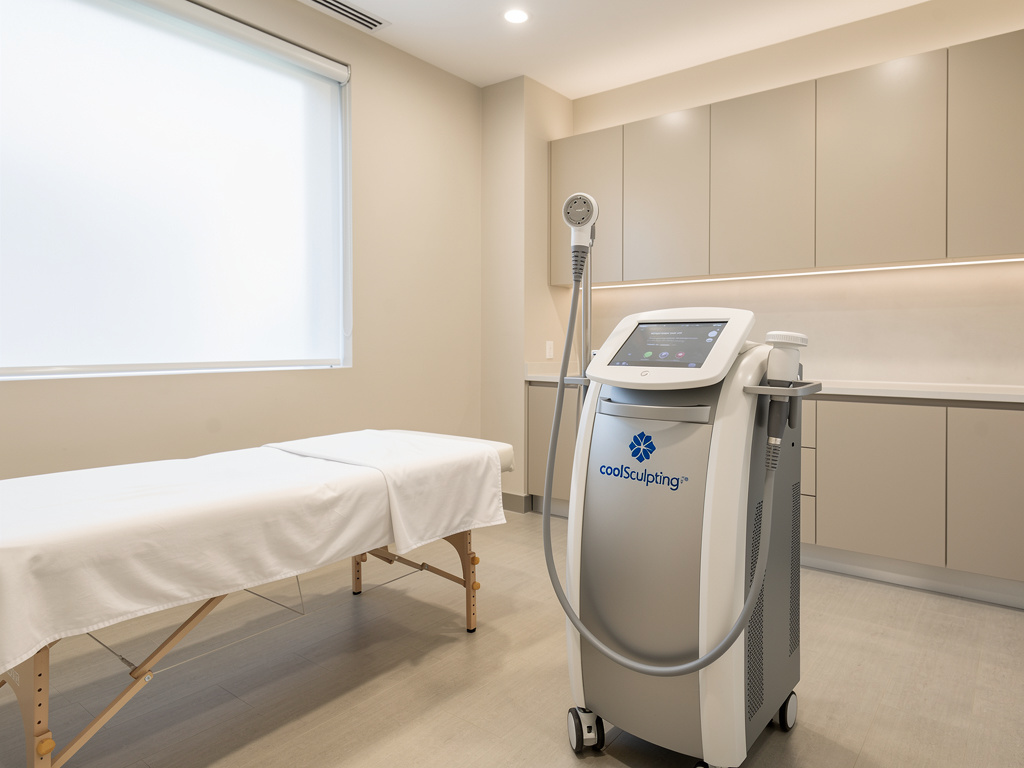
CoolSculpting uses cryolipolysis — controlled cooling that selectively destroys fat cells in the treated area. The device's applicator is placed over the skin and draws the underlying fat layer into a cooling chamber.
Here's the critical limitation: CoolSculpting can only treat what the applicator can reach. The applicator accesses subcutaneous fat — the layer above the muscle — because that's what can be drawn into the device. Visceral fat sits behind the abdominal wall, physically inaccessible to any externally-applied device.
This isn't a weakness in CoolSculpting specifically; no external fat-reduction device on the market reaches visceral fat. Visceral fat only responds to systemic approaches: sustained caloric deficit, strength training (which increases insulin sensitivity), GLP-1 medications, HRT in appropriate cases, and genuine metabolic intervention.
The practical result: if your menopause belly is 60% subcutaneous and 40% visceral, CoolSculpting addresses the 60%. If it's 30% subcutaneous and 70% visceral, CoolSculpting addresses the 30%. The pinch test at consultation reveals the proportion.
The pinch test that actually matters
Every Bravo MedSpa CoolSculpting consultation starts with a hands-on assessment of the abdomen. We pinch the area between thumb and finger to measure the subcutaneous layer thickness.
If you can pinch 2+ centimeters of tissue: You're a strong CoolSculpting candidate. The subcutaneous layer is meaningful enough to produce visible reduction with 2 to 4 cycles.
If you can pinch 1 to 2 centimeters: Moderate candidate. CoolSculpting will produce some reduction, but you should set expectations accordingly — this will be noticeable to you but not dramatic.
If you can pinch less than 1 centimeter but still have abdominal protrusion: The problem is predominantly visceral fat or abdominal muscle weakness. CoolSculpting isn't the right tool. We'll typically recommend CoolTone plus strength training plus discussion with your primary care about metabolic evaluation.
This honest assessment is what separates good practices from ones that'll sell you CoolSculpting regardless of whether it's the right treatment.
The menopause belly combination plan
For clients with a mix of subcutaneous and visceral belly fat (which is most menopause belly cases), a combination approach produces much better results than CoolSculpting alone.
Phase 1 — CoolSculpting (weeks 1 to 8). 2 to 4 cycles across upper and lower abdomen, spaced 4 to 6 weeks apart. Visible subcutaneous reduction develops over 8 to 12 weeks post-final cycle.
Phase 2 — CoolTone (weeks 6 to 12). 4 to 6 sessions of CoolTone on the abdominal wall, spaced weekly. CoolTone uses magnetic pulses to force supramaximal muscle contractions — it builds muscle, strengthens the abdominal wall, and improves the metabolic environment that over time reduces visceral fat.
Phase 3 — RF skin tightening (weeks 10 to 16). If skin laxity becomes visible after fat reduction — common in menopause-age clients due to reduced collagen — we add RF skin tightening sessions to address the loose skin.
Total timeline: 16 to 20 weeks from first CoolSculpting to final RF skin tightening. Most clients see peak results around week 20 to 24.
What lifestyle work adds to the picture
The combination plan above addresses what aesthetic devices can address. It doesn't replace the lifestyle work that addresses visceral fat itself.
Strength training. Two to three sessions per week of resistance training is the single most effective lifestyle intervention for menopause visceral fat. Muscle tissue increases insulin sensitivity and drives down visceral fat over 6 to 12 months. We routinely recommend clients start before or alongside CoolSculpting treatment, not after.
Protein-forward nutrition. Higher daily protein intake (1.2 to 1.6 grams per kilogram bodyweight) preserves lean mass during any weight changes and supports muscle building from strength training. Menopause accelerates natural muscle loss; nutrition is how you push back.
HRT discussion with your OB/GYN. Hormone replacement therapy, where appropriate, specifically addresses the hormonal driver of visceral fat accumulation. Not appropriate for every client, but worth having the conversation with your medical provider before concluding that CoolSculpting alone is your path.
Sleep and stress management. Cortisol dysregulation is a real contributor to visceral fat. Sleep quality and stress reduction aren't aesthetic-device levers, but they change the underlying picture.
What to expect during and after treatment
CoolSculpting sessions take 35 to 45 minutes per applicator. Most clients tolerate treatment well — intense cold for the first 5 to 10 minutes, then numbness, then 10 to 15 minutes of post-treatment massage to activate the fat-cell destruction process.
Post-treatment: mild redness, tingling, and temporary numbness in the treated area for a few days. Occasional bruising for 1 to 2 weeks. No activity restrictions — you can exercise the same day.
Visible results timeline:
- Weeks 1 to 4: Minimal visible change.
- Weeks 4 to 8: Gradual visible reduction begins.
- Weeks 8 to 12: Most visible change appears.
- Weeks 12 to 16: Final results settle.
Clients often come to their 4-week follow-up underwhelmed and leave happier at their 12-week follow-up. Patience with the timeline matters.
Cost and consultation at Bravo MedSpa
CoolSculpting pricing at Bravo MedSpa is per cycle: from $750 per cycle. A typical menopause belly plan (4 cycles across upper and lower abdomen, plus 4 to 6 CoolTone sessions, plus 3 to 4 RF skin tightening sessions) runs $4,500 to $7,000 total. See our Connecticut CoolSculpting cost guide for full per-area breakdowns.
Every plan starts with a 45-minute complimentary consultation at West Hartford or Rocky Hill. We'll pinch-test the abdomen, assess muscle tone, discuss your menopause timeline and any HRT conversations, and map a realistic plan. Book your consultation here.
About the author
Alica Bravo, RN
Connecticut-licensed Registered Nurse, Allergan Medical Institute certified, Galderma Advanced Injector. Founder of Bravo MedSpa.
Full profile →